
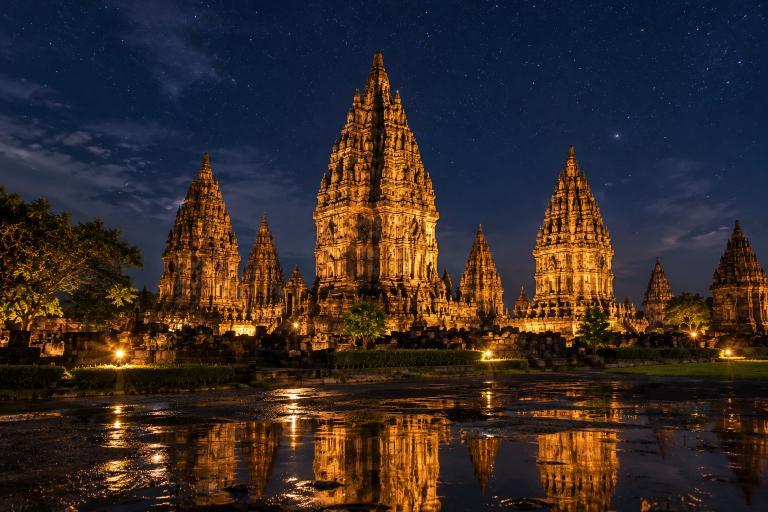

Prambanan Temple is one of the most iconic cultural destinations in Indonesia. Located in Yogyakarta, this magnificent Hindu temple complex represents the artistic achievement, religious heritage, and architectural brilliance of ancient Java. For travelers exploring Prambanan temple Indonesia heritage, Prambanan is an essential destination that should not be missed.
Prambanan was built during the 9th and 10th centuries under the Mataram Kingdom. It was created as a major center of Hindu worship and dedicated to the Trimurti: Shiva, Vishnu, and Brahma. The central temple, dedicated to Shiva, is the tallest structure in the complex and rises to approximately 47 meters. Its pointed tower dominates the surrounding landscape and symbolizes the sacred connection between humans and the divine.
The complex contains hundreds of temples arranged in concentric zones. The most sacred structures are placed at the center, while smaller shrines surround them. This layout reflects Hindu cosmology and demonstrates the advanced planning skills of ancient Javanese builders. Every part of the complex was designed with symbolic meaning, from the placement of the temples to the direction of their entrances.
One of the most remarkable features of Prambanan is its stone carving. The walls of the main temples are covered with detailed reliefs from the Ramayana epic. These carvings tell the story of Prince Rama, his wife Sita, and the monkey hero Hanuman. The reliefs present themes of loyalty, courage, sacrifice, and the triumph of good over evil. They are considered masterpieces of Hindu-Javanese art.
Prambanan is also known as Candi Roro Jonggrang. This name comes from a popular Javanese legend about a princess who was turned into stone. According to the story, a prince was challenged to build one thousand temples in one night. The princess tried to stop him by creating the illusion of dawn, and as punishment, she was transformed into stone. This legend adds a mystical atmosphere to the temple and remains an important part of local culture.
The temple complex faced many challenges throughout its history. Earthquakes, volcanic eruptions, and political changes led to its decline in the early 11th century. Many structures collapsed, and the site was eventually abandoned. It was rediscovered centuries later, and restoration efforts have continued ever since. In 2006, a powerful earthquake in Yogyakarta caused significant damage, requiring further conservation work.
In 1991, Prambanan Temple Compounds was recognized as a UNESCO World Heritage Site. This status highlights the temple’s exceptional cultural and architectural value. The recognition also covers nearby temple complexes such as Sewu, Lumbung, and Bubrah. The presence of both Hindu and Buddhist monuments in the same area shows the religious diversity of ancient Java.
Prambanan is located about 17 kilometers northeast of Yogyakarta city center, making it easy to reach for both local and international visitors. Travelers can combine a visit to Prambanan with other famous attractions such as Borobudur, Sultan Palace, Malioboro Street, and Mount Merapi. The site is part of the wider Prambanan Archaeological Park, which preserves several important heritage areas.
The best time to visit Prambanan is in the morning or late afternoon. Morning visits offer cooler weather and softer light, while late afternoon creates dramatic golden views around the temple towers. Visitors should wear comfortable shoes, bring drinking water, and follow the site’s preservation rules.
Prambanan is more than a tourist attraction. It is a symbol of Indonesia’s history, creativity, and spiritual heritage. Its towering temples, detailed carvings, and sacred atmosphere make it one of the most important cultural sites in Southeast Asia. For anyone interested in Indonesian heritage, Prambanan offers an unforgettable journey into the country’s ancient past.
